✨ New Arrivals Just Dropped!Explore

1 / 2
LRMSMSLR
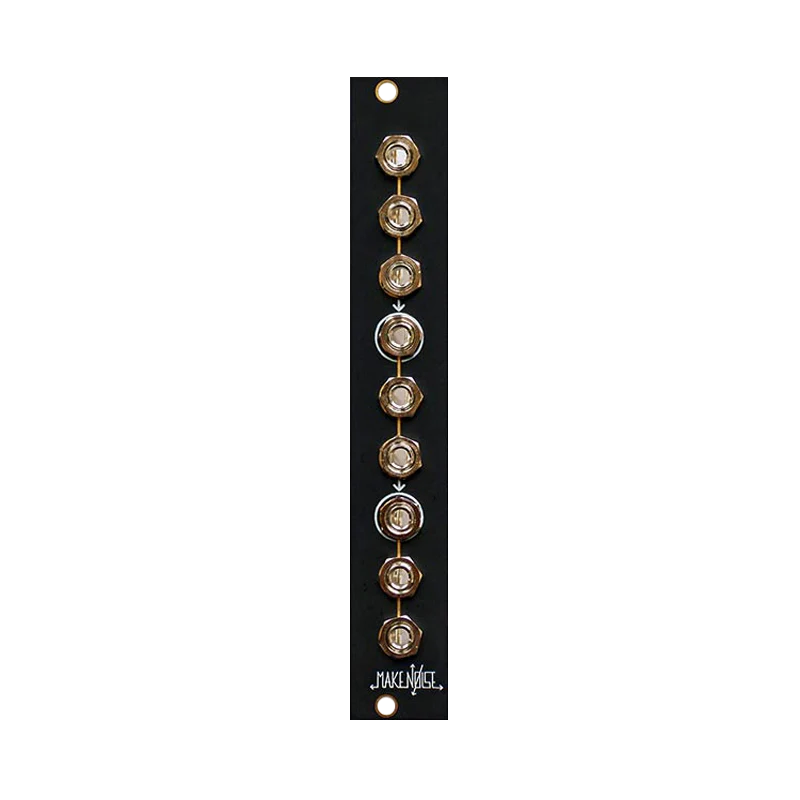
The LRMSMSLR brings the power of mid/side processing to the world of Eurorack. Mid/side processing is a powerful tool often utilised in mastering studios; it takes a stereo signal and separates it into the mid and side elements, allowing you to independently process them and then recombine them into a stereo signal.
Used creatively this allows a sound designer to do anything from using two filters with differing responses on a stereo signal without having to perfectly match them for a balanced stereo response, to using a VCA to modulate the stereo width at audio rates to add harmonics to a stereo signal, to techniques which haven’t even been invented yet. The inputs and outputs are DC coupled so the LRMSMSLR can be used to get a sum and difference from two CV signals to create complex dynamic CV signals from simple LFOs and envelopes.
Used creatively this allows a sound designer to do anything from using two filters with differing responses on a stereo signal without having to perfectly match them for a balanced stereo response, to using a VCA to modulate the stereo width at audio rates to add harmonics to a stereo signal, to techniques which haven’t even been invented yet. The inputs and outputs are DC coupled so the LRMSMSLR can be used to get a sum and difference from two CV signals to create complex dynamic CV signals from simple LFOs and envelopes.
$52.15
Original: $149.00
-65%LRMSMSLR—
$149.00
$52.15Product Information
Product Information
Shipping & Returns
Shipping & Returns
Description
The LRMSMSLR brings the power of mid/side processing to the world of Eurorack. Mid/side processing is a powerful tool often utilised in mastering studios; it takes a stereo signal and separates it into the mid and side elements, allowing you to independently process them and then recombine them into a stereo signal.
Used creatively this allows a sound designer to do anything from using two filters with differing responses on a stereo signal without having to perfectly match them for a balanced stereo response, to using a VCA to modulate the stereo width at audio rates to add harmonics to a stereo signal, to techniques which haven’t even been invented yet. The inputs and outputs are DC coupled so the LRMSMSLR can be used to get a sum and difference from two CV signals to create complex dynamic CV signals from simple LFOs and envelopes.
Used creatively this allows a sound designer to do anything from using two filters with differing responses on a stereo signal without having to perfectly match them for a balanced stereo response, to using a VCA to modulate the stereo width at audio rates to add harmonics to a stereo signal, to techniques which haven’t even been invented yet. The inputs and outputs are DC coupled so the LRMSMSLR can be used to get a sum and difference from two CV signals to create complex dynamic CV signals from simple LFOs and envelopes.